Houses
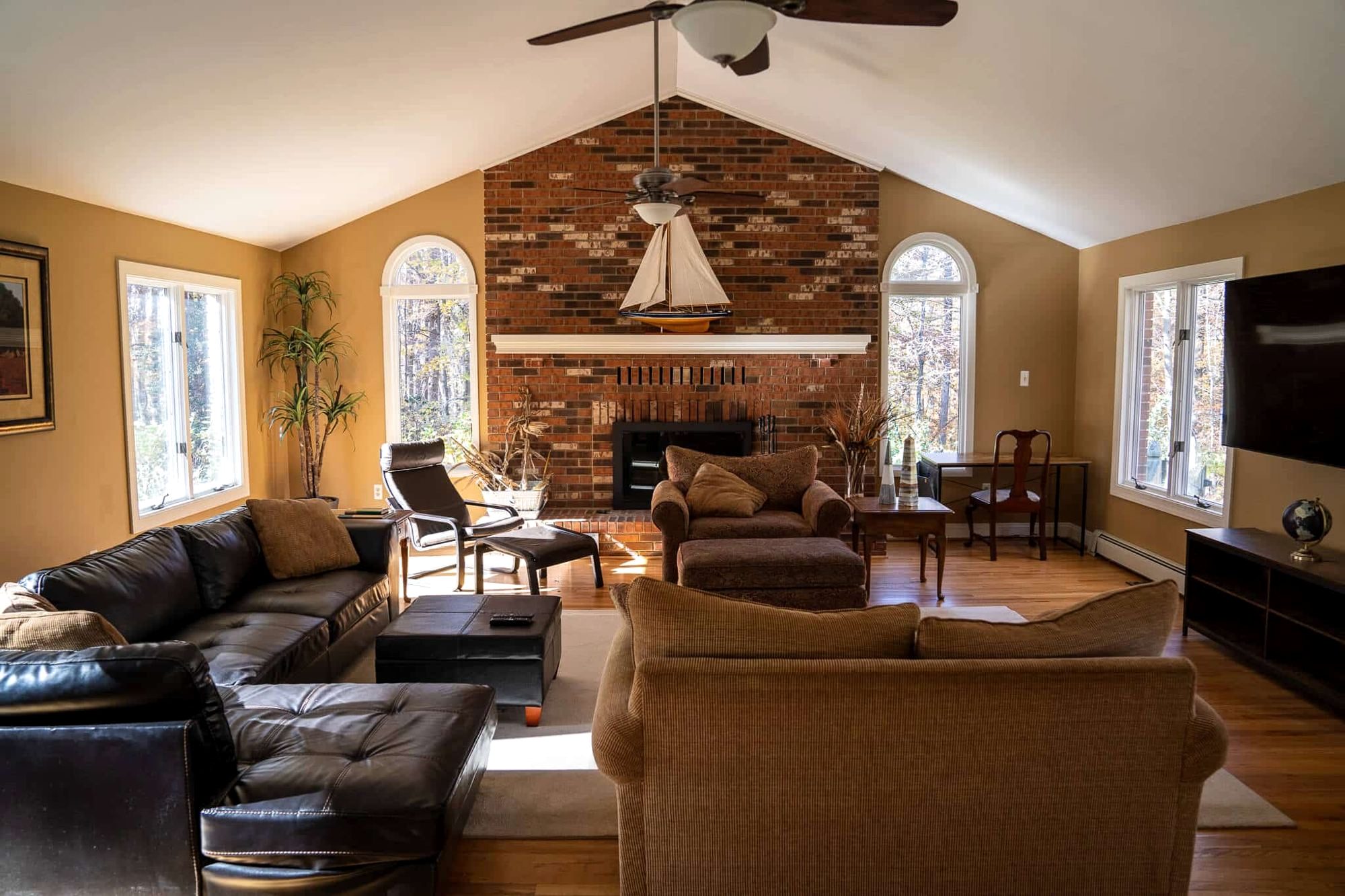
Crownsville · the living room. A house for twelve men, 20 minutes by car from Annapolis.
For anyone choosing where to live after treatment
Sober living vs. halfway house
“Halfway house” is one phrase for several different places: a residence for people leaving prison or on probation or parole, a low-intensity treatment service under Maryland law, or, loosely, any sober house. Here is what each one is, in the words of the agencies and laws that define them, and what Severn Home is in those terms.
What a halfway house is
The phrase is used for three different places. Only the third is a sober living house.
Leaving prison. The federal Bureau of Prisons “contracts with residential reentry centers (RRCs), also known as halfway houses,” for “inmates who are nearing release.” Virginia’s Department of Corrections has Community Residential Programs, which “may be used for any probationer or parolee as needed for gradual release,” among other uses. Both are run by, or under contract to, a corrections agency, for the people it supervises.
In treatment. Maryland’s Health-General Article, in section 8-101, gives the phrase a second, narrower meaning: “‘Halfway house’ means a clinically managed, low intensity residential treatment service for individuals with substance-related disorders who are capable of self-care but are not ready to return to independent living.” The same section defines a recovery residence, quoted below. One is a treatment service; the other is housing.
Loosely, any sober house. The third use is the everyday one. Some people search for this as a halfway house. Severn Home is sober living: gender-specific houses for adults in recovery, with house rules and no medical or clinical services. A mentor checks in daily for your first month, and the rules lift in five stages over the year.
What a recovery residence is
Both states have a legal name for sober housing: a recovery residence. Maryland’s law says: “‘Recovery residence’ means a service that: (1) Provides alcohol-free and illicit-drug-free housing to individuals with substance-related disorders or addictive disorders or co-occurring mental disorders and substance-related disorders or addictive disorders; and (2) Does not include clinical treatment services.”
Virginia’s law says: “‘Recovery residence’ means a housing facility that provides alcohol-free and illicit-drug-free housing to individuals with substance use disorders and individuals with co-occurring mental illnesses and substance use disorders that does not include clinical treatment services.” In both states the last clause is the point: it is housing, and treatment is not part of it.
The National Alliance for Recovery Residences, whose standards the Virginia statute names, sorts recovery residences into four levels. “All recovery residences offer alcohol and illicit substance-free living environments and utilize a social model recovery approach.” “Level II Type M (Monitored) are frequently called sober homes or sober living.” Level IV, “Type C (Clinical),” is the one that “integrates the social and medical model.”
Each state’s law calls for a public list. Maryland’s requires its Department of Health to publish “A list of each recovery residence operating in each county in the State,” which “shall indicate whether the owner of a recovery residence has received a valid certificate of compliance.” Virginia’s requires its Department of Behavioral Health and Developmental Services to keep lists of recovery residences on its website, and adds: “Every recovery residence shall disclose to each prospective resident its credentialing entity.”
What Severn Home is
In those terms, Severn Home is sober living: “Structured, gender-specific recovery housing for adults.” It is housing, not treatment. Whoever is asking, for yourself, for someone you love, or as a case manager placing someone, the way in is the same: call or text 443-223-7403, say who the room is for and the day they leave treatment, and ask which houses have a room open and the rent for that room.
It is for adults leaving residential addiction treatment who want structure around their first year: four recovery meetings a week to start, a sponsor, a mentor who checks in daily for the first month, and a curfew that extends as you earn it. Some residents see a private therapist; others attend an outside intensive outpatient program while they live here.
There are seven houses: one for women, in the Ellicott City area, and six for men, in Arnold, Crownsville, Gambrills, Pasadena and Silver Spring, Maryland, and in Alexandria, Virginia. A house for men in Fairfax, Virginia, is opening October 2026.
The practical differences
If you are deciding between places, these are the questions to put to each one. Here is Severn Home’s answer to every one of them, or, where an answer is not published, what to ask on the phone.
1.
How you get in. Call or text 443-223-7403, or email [email protected]. Phone support is staffed Monday to Friday, 9 am to 5 pm.2.
Who pays. You pay rent. Where it is offered, a room shared by two is $1,200 a month, and a room of your own $1,500 to $1,800. Not every rate is offered at every home. Every amenity is included in the rate at every home.3.
The rules. Four recovery meetings a week in your first 30 days, a curfew, and signing in and out until day 90. From day 30, one overnight pass every other week. From day 150, no curfew and no set wake-up time. Curfew and wake-up times, visitors, cars and phones are house details to ask about when you call.4.
How long. The rules lift in five stages over the first year. We recommend a minimum stay of one year; from there, remain in the house as long as you can.5.
If someone uses. Every Severn Home is substance-free housing. Testing, and what follows a return to use, are house policies to ask about when you call or text 443-223-7403.6.
Work and school. If you do not already have a job, the search for one begins after your first 30 days. By stage four you must have a full-time job unless you are a student.
Where to read more
What sober living is has its own page, and so do the first year, stage by stage, the rooms and rates, the houses, and the ten questions to ask any house before you choose.
If you or a loved one need treatment, start with findtreatment.gov or the SAMHSA hotline at 1-800-662-4357.
Rooms from $1,200 a month. Call or text 443-223-7403. Phone support Monday to Friday, 9 am to 5 pm.